If no woman is safe, then all women should know their legal protections…
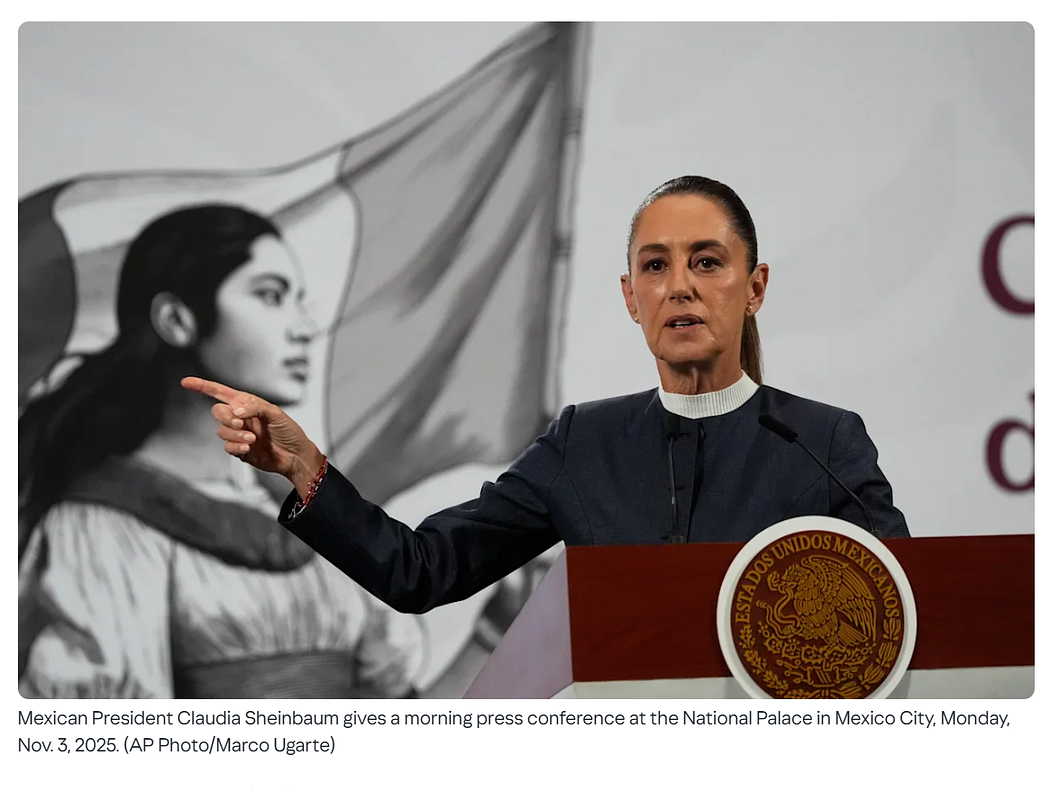
The morning sun trickled through the stone-pillars of the Palacio Nacional in Mexico as President Sheinbaum stepped out for what should have been a brief greeting of citizens. But in that moment, as a man surged forward, pressed his arm around her shoulder, attempted a kiss and laid his hand on her breast, the scene cracked open not just her personal dignity but the public façade of protection… for her and for all women.
For a nation where women report an average of ten femicides each day, and countless more assaults go unpunished, this was not only an attack on her, it became a televised metaphor for every woman whose body is treated as public domain.
Sheinbaum did not recoil. She filed charges. And she asked the question: “If this happened to me, what happens to the young women in the street?”
It’s a question that many women are asking right now, as the world watched that video stream across global news channels. If you’re angry about it, I am too!
So I’m doing what I can to help women in this situation. By spotlighting what the law says and what legal recourse women could have in multiple countries, starting with Mexico.
The Mexican Legal Landscape
What offences exist?
According to the Federal Penal Code (Código Penal Federal) of Mexico:
- Sexual abuse (Abuso Sexual): Unwanted touching or forcing someone to commit sexual act without penetration. Under Article 260, the offender may face six to ten years in prison and a fine of up to 200 days of income. If violence or coercion is used, the penalty increases by half.
- Sexual assault or rape (Violación): Under Article 265, non-consensual penetration or access via violence, threats or when victim cannot resist, may lead to 8 to 20 years in prison.
Importantly for this case: although Sheinbaum was not penetrated, the groping qualifies as unwanted sexual contact and thus likely falls under abuso sexual. Indeed one outlet noted that “the kiss, the touching … is not only harassment, it is a sexual assault … punishable with 1 to 6 years in prison” though state penalties vary.
Jurisdictional complexities
Mexico’s federal structure means each of the 31 states (and Mexico City) can define sexual harassment and assault differently. Half the states criminalize sexual harassment explicitly; many do not or have weak enforcement.
President Sheinbaum has called for harmonization: a nationwide offence for sexual harassment, stiffer penalties, faster processing, and recognition that public assault of a woman is an assault of all women. See why you should put women in charge of everything? Anyway, I digress…
Possible outcomes
For the man:
- He may be charged under the relevant state law for unwanted sexual contact, likely the Federal Article 260 or state equivalent.
- If convicted, a penalty of 6–10 years (or adjusted by state law) is plausible.
- If more aggravating factors (public figure, abuse of authority, presence of video, intoxication) are proven, higher sentences or additional charges (harassment, public indecency) might apply.
- There may also be civil remedies: the President has a right to press a complaint (“denuncia”) and the state can initiate prosecution even without her private lawsuit.
- The incident may prompt legislative change, strengthening women’s rights and legal avenues for harassment in Mexico City and nationwide.
For women in Mexico:
- The case sends a message: assault in public is not trivial, it may be prosecutable.
However, many survivors still face institutional barriers such as lack of reporting, weak investigations, social stigma. This case’s high profile helps but does not guarantee change.
In Canada: Sexual Assault Is a Broad, Serious Offence
Under Section 271 of the Canadian Criminal Code, sexual assault is any non-consensual touching of a sexual nature, regardless of intent to cause injury. It’s a hybrid offence, meaning the Crown can proceed either summarily (for minor cases) or by indictment (for serious cases).
In Sheinbaum’s scenario, a similar act in Canada, touching a public figure’s body without consent in a public event, would almost certainly lead to criminal charges, likely prosecuted as an indictable offence due to the public nature and violation of personal integrity.
The accused could face up to 10 years in prison, and aggravating factors like the victim’s public role or humiliation caused could influence sentencing. Don’t you just love Canada?
In the United States: Different State Laws, One Principle: Consent Is Everything
In the U.S., sexual assault laws vary by state, but the principle is the same, any non-consensual sexual contact is criminal. For example:
- In California, this would qualify as sexual battery under Penal Code S243.4, carrying up to four years in prison.
- In New York, it would be forcible touching under Penal Law S130.52, with potential jail time and sex offender registration.
Had the same happened to an American president, the Secret Service’s involvement would escalate it into a federal-level investigation, possibly adding assault on a federal officer under 18 U.S.C. S111.
In the United Kingdom: Sexual Assault Under the Sexual Offences Act 2003
In the U.K., touching another person sexually without consent is a violation of Section 3 of the Sexual Offences Act 2003. Conviction carries up to 10 years imprisonment, and the courts emphasize the victim’s autonomy over intent.
If the act occurred in public, the offender could also face additional public order charges. For instance, indecent assault in a public gathering could attract harsher sentencing to reflect societal outrage.
In Nigeria: Consent, Culture, and the Challenge of Enforcement
In Nigeria, sexual assault is addressed under the Criminal Code Act (applicable in southern states) and the Penal Code (applicable in the north). Both criminalize indecent assault, that is, touching a woman without consent in a sexually suggestive manner.
Under Section 360 of the Criminal Code, indecent assault of a woman is punishable by two years imprisonment. However, under the Violence Against Persons (Prohibition) Act (VAPP) 2015, which applies federally, the same act could be prosecuted as sexual harassment or indecent touching, carrying up to three years imprisonment or a fine of ₦500,000, or both.
The issue, though, is enforcement. In many Nigerian states, sexual assault cases are underreported and often trivialized, particularly when the offender is influential or the victim is expected to “overlook” the act.
That’s why this Mexican incident is more than just a headline, it’s a mirror reflecting how women’s bodily autonomy remains a global battleground, regardless of rank or geography.
The Global Thread: Power and the Politics of Touch
Across these five jurisdictions; Mexico, Canada, the U.S., the U.K., and Nigeria, the law speaks with one voice on this issue: consent is non-negotiable. Please read that again and say it out loud for those at the back!
Every system criminalizes unwanted sexual contact, even when it seems minor, because such acts chip away at the fundamental right to personal dignity.
Yet sadly, the force of enforcement differs. In countries like Canada and the U.K., robust prosecution frameworks mean even high-profile offenders face swift legal consequences. In others, such as Nigeria and parts of Latin America, cultural and institutional barriers can dilute the strength of the law, leaving victims dependent on social outrage rather than legal remedy.
For President Sheinbaum, pressing charges is not just about personal justice, it’s a political statement. It’s about showing that even the highest office in the land is not immune to gendered disrespect, and that the law must stand taller than the culture that excuses it.
This content, also shared on Law Bants, is for information and entertainment purposes only. It reflects personal opinions and does not constitute legal advice or create a lawyer-client relationship. If you need professional legal guidance, please consult a qualified attorney in your jurisdiction.